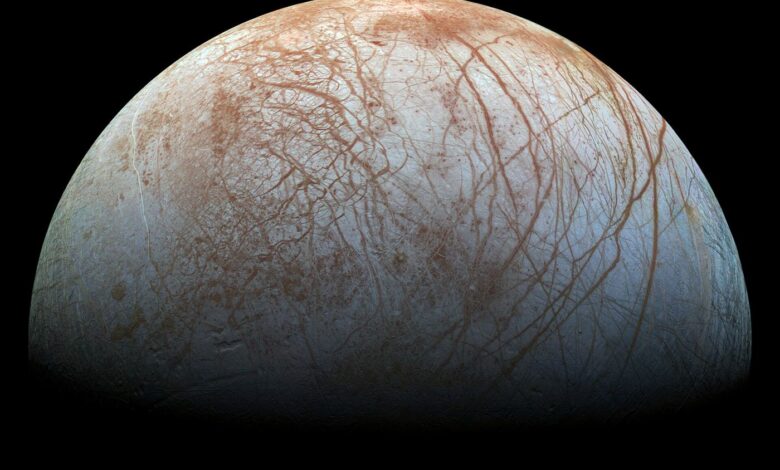
Beneath the cracked ice shell of Jupiter’s moon Europa, planetary scientists now suspect that lakes of liquid water may sit far closer to the surface than the moon’s famous deep ocean. The idea comes from comparing Europa’s chaotic terrain, vast regions where the ice has broken, shifted and refrozen, with volcanic features observed beneath Greenland’s ice sheet, where pockets of water collect and drain within the ice itself. If similar reservoirs exist on Europa, they would be dramatically easier for a future spacecraft to study than an ocean lying perhaps twenty kilometres down. They would also be scientifically precious: shallow lakes exchange material with the surface, where radiation creates chemical ingredients that could feed simple chemistry below. Researchers stress that the evidence is indirect, assembled from radar echoes, surface geology and modelling, but the hypothesis has reorganised how mission planners think about where to look first on this distant ocean world.
What the Evidence Shows
Testing the idea is the work of spacecraft now travelling or preparing to travel to the Jupiter system. Ice-penetrating radar carried by upcoming missions is designed to profile the shell’s structure and search for the bright reflections that liquid water produces, much as radar surveys map lakes beneath Antarctic ice. Scientists are also re-examining decades-old observations for plumes of water vapour that might connect shallow reservoirs to the surface. Laboratory experiments with salty ice under Europa-like conditions help interpret what the instruments will see, because brines remain liquid at far lower temperatures than pure water and behave differently under pressure. Even a negative result would be valuable, ruling out one of the few accessible environments on the moon. The enthusiasm reflects a wider shift in planetary science toward ocean worlds, where the ingredients for life, water, chemistry and energy, appear to coincide more often than anyone expected a generation ago. Reporting and analysis from sources such as Nature track the same developments, and specialists following shallow liquid water lakes inside Europa say the direction is now consistent across independent lines of evidence.
The Wider Context
The wider context is a research landscape in which replication and open data now decide reputations. Findings connected to shallow liquid water lakes inside Europa are being checked by independent groups with shared datasets, and the teams involved publish their methods in full so rivals can test every step. That discipline is slower than a headline cycle, but it is why results in this area increasingly survive first contact with scrutiny.
What Happens Next
What happens next in the story of shallow liquid water lakes inside Europa will be decided by follow-up work already under way: larger samples, longer observation and instruments that have not yet come online. The researchers involved are unusually united on one point, that the current results justify the next investment of time and money. Readers will not have to wait long for the first tests of that claim. You can follow related developments in our coverage of science.
None of this will be settled by a single announcement, study or product launch. The pattern to watch is accumulation: independent confirmations, honest reporting of failures and steady improvement in the underlying numbers. Readers who follow those signals, rather than the loudest claim of the week, will understand this subject better than most of the commentary surrounding it suggests is possible.