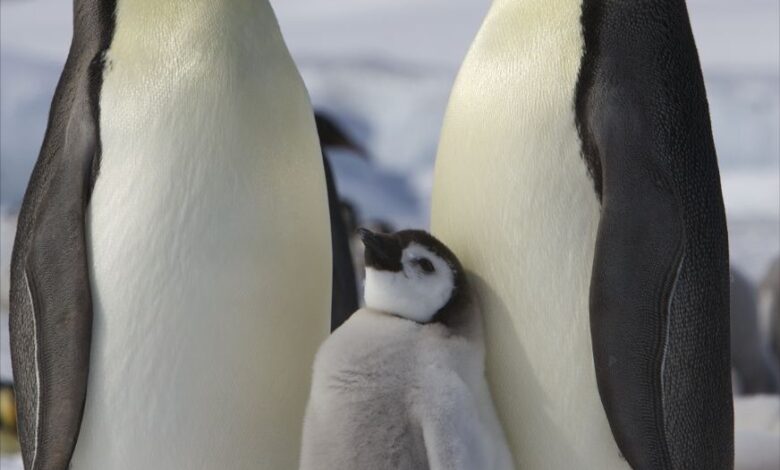
Emperor penguins breed in the middle of the Antarctic winter, in darkness and cold that can fall below minus forty degrees, with winds that drive snow horizontally across the ice. It is the only penguin species to do so, and its strategy is extraordinary. After the female lays a single egg, she passes it to her mate and walks back to the open sea to feed, leaving the male to balance the egg on his feet, tucked beneath a fold of warm belly skin, for more than two months without eating. The males gather in dense huddles, shuffling slowly so that each bird takes a turn in the sheltered centre and a turn on the freezing edge. By sharing body heat in this way, the colony survives conditions that would kill a lone bird in hours. When the chicks finally hatch, the females return just in time to take over.
What the Evidence Shows
The huddle is one of nature’s most remarkable feats of cooperation. Thermal cameras have shown that the temperature inside a tight huddle can rise well above freezing, even while the air outside is bitterly cold, and the birds constantly adjust their positions to keep the warmth evenly shared. The males lose up to half their body weight during the long fast, living off fat stored before the winter began. Once the chicks hatch, both parents take turns making the long walk to the sea and back, bringing food while the other guards the chick. Climate change now threatens this cycle, because the sea ice the penguins breed on is forming later and breaking up earlier. If the ice disappears before the chicks are ready to swim, the colony can fail, and researchers are watching the ice closely each year. Reporting and analysis from sources such as National Science Foundation track the same developments, and specialists following the emperor penguins huddling through the Antarctic winter say the direction is now consistent across independent lines of evidence.
The Wider Context
The wider context is a research landscape in which replication and open data now decide reputations. Findings connected to the emperor penguins huddling through the Antarctic winter are being checked by independent groups with shared datasets, and the teams involved publish their methods in full so rivals can test every step. That discipline is slower than a headline cycle, but it is why results in this area increasingly survive first contact with scrutiny.
What Happens Next
What happens next in the story of the emperor penguins huddling through the Antarctic winter will be decided by follow-up work already under way: larger samples, longer observation and instruments that have not yet come online. The researchers involved are unusually united on one point, that the current results justify the next investment of time and money. Readers will not have to wait long for the first tests of that claim. You can follow related developments in our coverage of science.
There is a practical lesson in all of this for readers deciding what to do today. Start with the verified facts, be wary of anyone promising certainty, and prefer reversible steps while the evidence is still developing. Circumstances differ by country, income and personal situation, so general guidance should always be weighed against your own context before you act on it in any significant or lasting way.