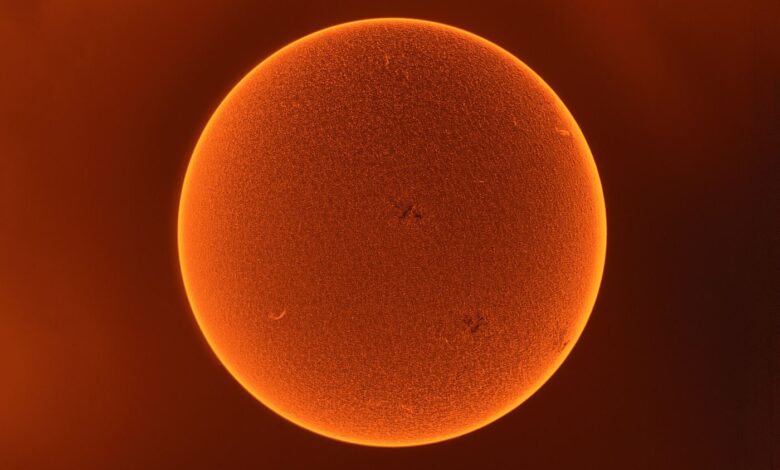
For the first time in history, humanity has seen the Sun’s poles. In March 2025, the European Space Agency’s Solar Orbiter tilted its orbit 17 degrees out of the ecliptic plane, the flat disc in which the planets orbit, and looked at the Sun from below, photographing its south pole on 23 March. Until then every image of the Sun had been taken from near the equator, because no spacecraft had ever climbed out of the plane. Solar Orbiter, a joint ESA and NASA mission launched in February 2020, used a flyby of Venus in February 2025 to bend its orbit upward, and its three instruments, the Polarimetric and Helioseismic Imager, the Extreme Ultraviolet Imager and SPICE, all captured the polar region. The images were released in June 2025. It was the first time any spacecraft had looked down on the Sun’s poles, a view astronomers had wanted for more than half a century.
What the Evidence Shows
The first surprise was how chaotic the polar magnetic field looks. The images show the Sun’s magnetic field at the south pole in a state of turmoil, with mixed polarities tangled together, and scientists say the poles are the key to understanding the solar cycle, the roughly eleven-year rhythm of sunspots and solar storms. The magnetic field at the poles flips at the peak of each cycle, and the details of that flip set the strength of the next one. Solar Orbiter will keep climbing: a further Venus flyby on 24 December 2026 will tilt its orbit to 24 degrees, giving even better views of both poles. Understanding the poles also matters for space weather, because the solar wind that streams from them can disturb satellites and power grids on Earth. The best pictures of the Sun’s hidden regions are still to come. Reporting and analysis from sources such as National Science Foundation track the same developments, and specialists following Solar Orbiter views of Sun poles say the direction is now consistent across independent lines of evidence.
The Wider Context
The wider context is a research landscape in which replication and open data now decide reputations. Findings connected to Solar Orbiter views of Sun poles are being checked by independent groups with shared datasets, and the teams involved publish their methods in full so rivals can test every step. That discipline is slower than a headline cycle, but it is why results in this area increasingly survive first contact with scrutiny.
What Happens Next
What happens next in the story of Solar Orbiter views of Sun poles will be decided by follow-up work already under way: larger samples, longer observation and instruments that have not yet come online. The researchers involved are unusually united on one point, that the current results justify the next investment of time and money. Readers will not have to wait long for the first tests of that claim. You can follow related developments in our coverage of science.
There is a practical lesson in all of this for readers deciding what to do today. Start with the verified facts, be wary of anyone promising certainty, and prefer reversible steps while the evidence is still developing. Circumstances differ by country, income and personal situation, so general guidance should always be weighed against your own context before you act on it in any significant or lasting way.